
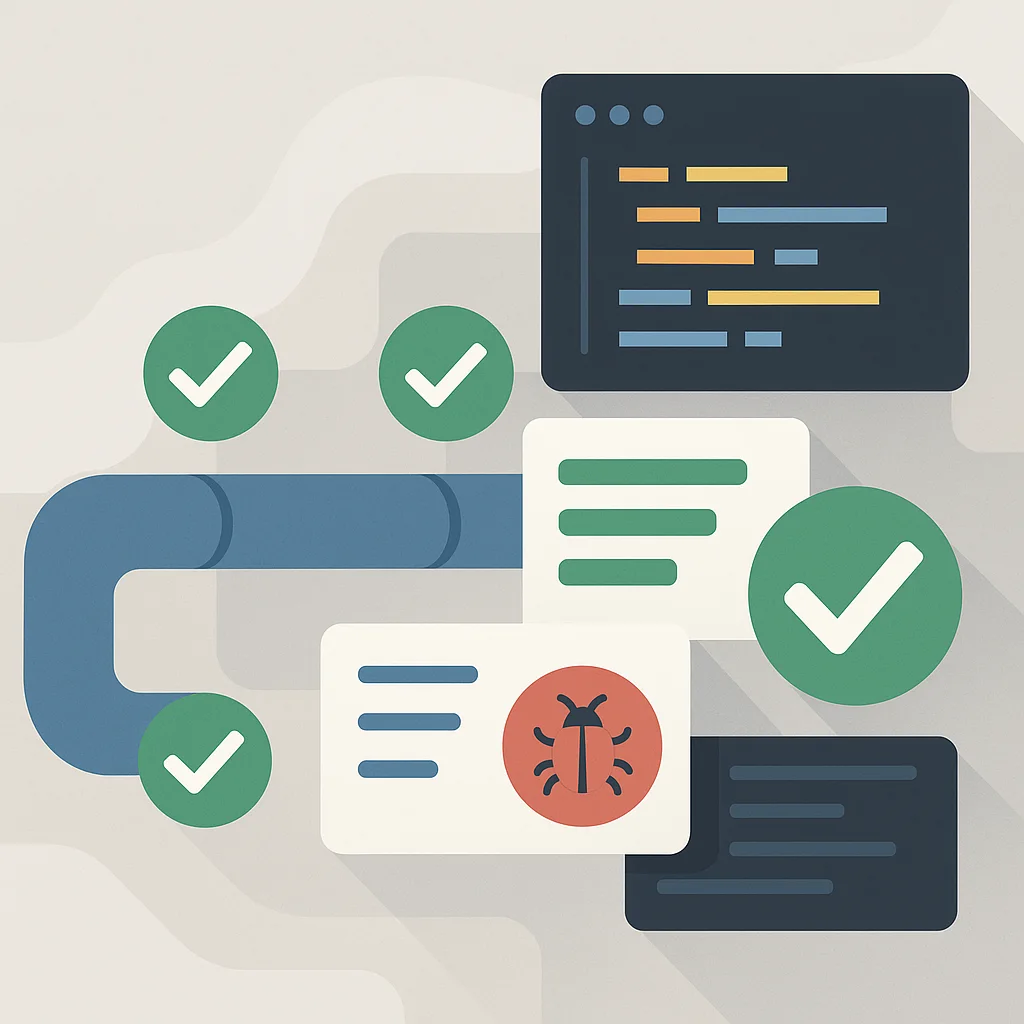
AI-generated code can glide through your CI pipeline — lint clean, tests green, coverage above the threshold — and still ship a bug no one thought to test for. This article explains why AI code can pass Continuous Integration (CI) checks designed for a different era of failures, and offers a short list of practical, zero-budget gates to catch what today’s CI pipelines can’t.
A few months ago, during a project piloting an AI-based pull-request reviewer, I watched a change pass our Continuous Integration (CI) pipeline in under four minutes. Lint was clean. Unit tests were green. Coverage was above our threshold. The dashboard even tossed the little green confetti it reserves for merges it’s especially happy about. It looked just like the hundred safe merges before it. Two days later, a downstream dashboard began showing physically impossible temperature readings for one specific tag — its raw-to-engineering-unit scaling had quietly flipped from Celsius to Fahrenheit under one code path — an edge case no one, human or AI, had thought to test.
Nothing about that CI pipeline misled us. It answered every question we had configured it to ask. We simply hadn’t updated the questions for the kinds of mistakes AI-generated code tends to produce. That gap — between what a green build demonstrates and what we assume it demonstrates — is the real issue with AI-assisted development right now. It’s also fixable, and fixing it doesn’t require new tooling spend, just a different set of gates.
The gap nobody’s CI pipeline measures
A controlled study published in 2023 gave one group of developers access to an AI coding assistant and left another group without it, then asked both groups to complete the same security-relevant programming tasks. The AI-assisted group produced measurably less secure code on most tasks. The second finding is the one worth dwelling on: the AI-assisted group was also more confident their code was safe than the unassisted group. Confidence rose at the same time correctness fell.
A separate randomized trial in 2025 found a similar pattern in productivity rather than security. Experienced developers working in their own large, familiar codebases were measurably slower when using AI assistance on complex tasks, despite predicting beforehand that the tools would speed them up. Afterward, even after being slower, they still believed the tools had helped — the engineering equivalent of a driver flooring it right after the low-tire-pressure light turns on. Neither a test suite nor a green checkmark can capture that mismatch. A build has no way to know whether the person or agent producing it was overconfident — it only knows whether the code executed.
Why the CI pipeline stays green while the codebase gets worse
Coverage percentage and a passing test suite tell you about a single diff, in isolation, at a single point in time. They don’t describe what’s happening to the codebase as it evolves. One 2025 analysis of more than 200 million lines of committed code found that duplicated code blocks increased by roughly eightfold, and the share of code rewritten within two weeks of being committed roughly doubled, over the period when AI coding assistants moved from novelty to default. Over the same span, deliberate refactoring — the maintenance work that keeps a codebase understandable — dropped from about a quarter of all changed lines to under a tenth. It’s the codebase equivalent of five people bringing the same casserole to Thanksgiving because no one checked what was already on the table.
None of that triggers a red X. Lint doesn’t fail because code is duplicated. Tests can pass for a function that will be rewritten again in nine days. A CI pipeline evaluates each pull request as though it stands alone, so a codebase can become objectively harder to maintain while each individual commit that contributed to the decline still sailed through review with a green light.
The bug class your linter can’t see
Independent testing published in 2026, run across five current AI models, found that roughly one in 22 to one in 16 code completions still referenced a software package that doesn’t exist — a plausible-sounding name the model invented rather than something drawn from a real library index. Dozens of those invented names were still unregistered, meaning anyone could claim one and wait for a model to keep suggesting it to unsuspecting developers, a supply-chain risk now commonly called slop squatting — somewhere, a domain squatter owes several AI labs a thank-you card.
A hallucinated import can be syntactically valid. It looks fine to a linter and may survive a test suite that mocks its dependencies. It tends to fail only at install time, or when someone registers the name a model keeps guessing — which means the tooling most teams already run isn’t set up to catch it at all.
How to actually close the gap
The fix isn’t a smarter model or a stricter linter. It’s a small set of additional gates, each aimed at a specific failure mode described above, and none of them require new tooling budget.
What to avoid
Final thought
The CI pipeline that missed our temperature-scaling bug wasn’t broken. It was answering last decade’s question perfectly — it just wasn’t the question that mattered anymore. The fix wasn’t a smarter model or a longer test suite. It was asking a different question of the code in front of us: not “did this run,” but “what would have to be true for me to actually trust it?” That’s a question worth asking about every green build on your screen right now — including the ones that throw confetti.