

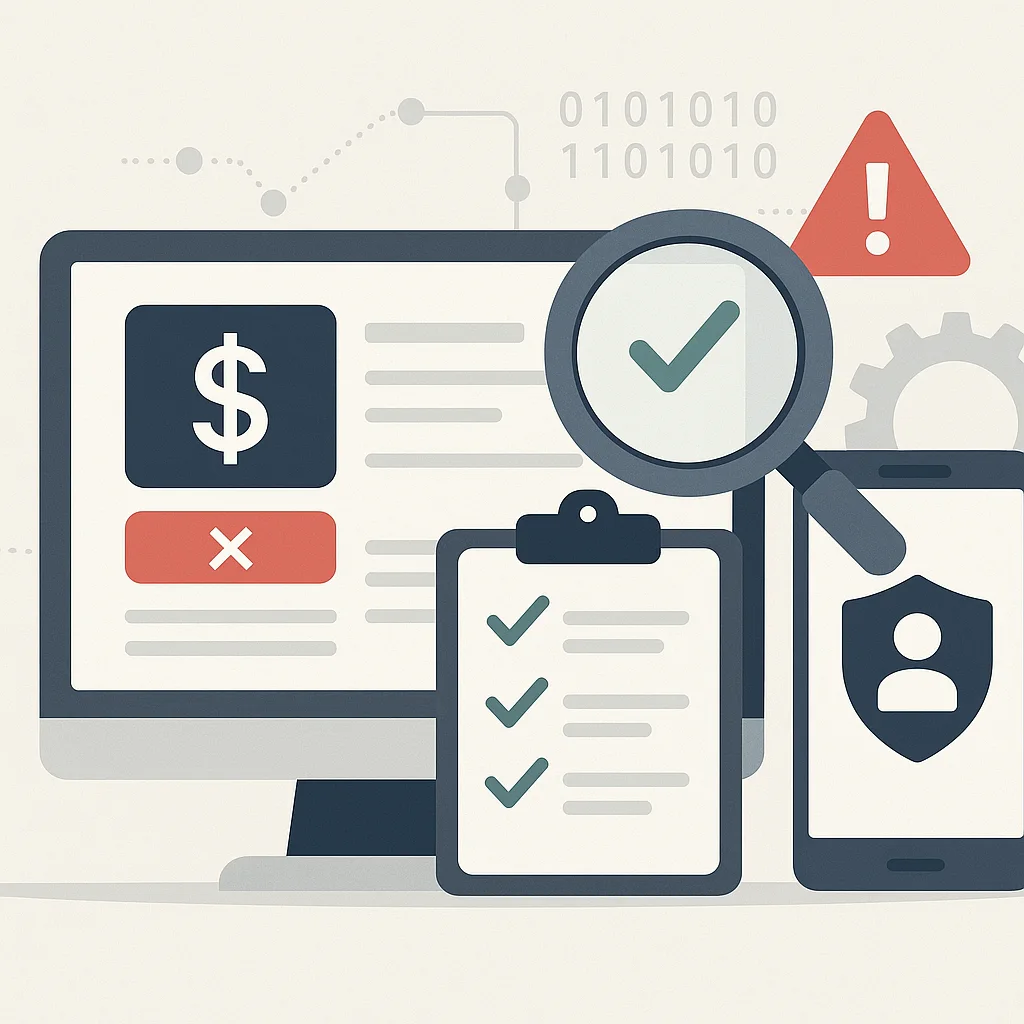
It takes a million transactions to build trust and only one to destroy it. Adding to the challenges modern fintech products face, they handle not only money but also users’ personal data, time, and expectations. Balancing all of this demands careful planning and continuous testing—testing, testing, testing. During testing, it’s beneficial for things to fail so they can be rebuilt reliably and released to production as smoothly as possible.
Why Is Fintech Software Testing So Challenging?
Two reasons: AI and human error. AI is a tool, and like any tool, its effectiveness depends on how it’s used. Malicious actors can use AI to probe, chip away, and find ways to worm into a fintech app. At the same time, everyday users can make honest mistakes that trigger serious consequences.
In addition, tests may not be thorough enough (requiring updates), tight deadlines can force crunch, and errors are more likely under pressure. Phishing attempts using brand impersonation can affect even strong systems, and sometimes the issue is as simple as insufficient funds.
One thing is clear: even a small defect in security code can trigger a cascading failure—impacting many (or all) transactions, causing loss of account access, and undermining customer trust.
Banks sit at the center of most transactions. Multiply that by the number of countries a fintech app supports, then add payment providers and identity-verification services, and you get a recipe for disaster—or major success, if the app manages to balance everything effectively.
Common Software Testing Challenges in Fintech
“Common” means widely understood, but revisiting the fundamentals is always worthwhile. The core of every fintech app is its transactions, which can be successful, failed, pending, duplicated, or interrupted. Each outcome has its own causes, and grouping them is a useful first step in security testing.
Testing Payments and Transactions
What are the key attributes that define a transaction as successful or failed? Quickly addressing more problematic cases improves cash flow and frees up valuable resources to verify amounts, currency types (and therefore exchange rates), banking and payment processor fees, user balances, and refund requests.
Running end-to-end tests before deployment is a solid approach, but it requires time and must be accounted for in planning. A Plan B is to automate these tests, reducing regressions for each release and cutting down the time needed for manual or ad-hoc testing. However, what works well in theory still requires time to implement effectively in practice.
Partnering can save time. Working with a QA testing partner brings specialized experience, freeing up time for strategic decisions. These partnerships can help strengthen QA processes, expand test coverage, and improve overall product security.
Protecting User Data and Accounts
APIs are so fundamental that their presence is no longer a competitive advantage. Still, they remain a security risk because they often provide the most direct access point for third parties into a system.
That’s why additional layers of protection are needed—not only against attackers trying to exploit API requests, but also against those targeting other edge cases. Two-factor authentication, email authorization for each transaction, session length limits, and robust account recovery supported by trained customer support agents form key first lines of defense.
Testing KYC and Identity Verification
Test three times, deploy once. Users upload personal, government-issued documents, and the safeguards protecting them should be as strong as the institutions that issue them. What happens if the system flags a legitimate document as faulty and rejects it?
A practical path forward is manual review or implementing biometrics—but then comes the challenge of scaling this with the number of uploads per day, per country, and per user. The volume can become extremely high, often leading to partial automation and investment in well-trained customer care agents who can handle everything from slow periods to sudden spikes in requests.
Managing Third-Party Integrations
We’ve covered APIs; now add the reality that APIs change with upgrades and inevitably evolve over time. A fintech app that lasts more than, say, five years will go through multiple iterations. Its API documentation must keep pace, helping prevent avoidable errors.
Fintech apps should also be tested regularly for server or power outages, especially when they rely on connected infrastructure across multiple countries. How will traffic reroute? What happens if a sudden spike slows responses and clogs the flow? What if a payment fails during an international transaction? Security works best when it has enough time and resources to process tens of requests.
What about a hundred? Thousands? Millions? The answer can’t always be “add more servers,” because banks, payment gateways, and card processors each have their own requirements that the fintech app must follow.
Testing Across Devices and Markets
What works securely on one device may not work the same way on another. The challenge grows as fintech apps scale across multiple operating systems and versions, spanning mobile, tablet, desktop, and smartwatch—each operating within different carrier ecosystems. A strong approach is to maintain dedicated teams for at least different operating systems, so they can specialize and adapt to device-specific behavior.
International expansion adds another layer: each country has its own currencies, legal systems, date formats, and payment methods. Maintaining safety often requires local expertise, since teams familiar with a region can perform location-based testing and real-device usage more effectively.
Maintaining Performance and Reliability
Fintech users expect convenience, which effectively means 100% uptime. Achieving that requires resolving issues in real time—bridging timeouts with backup servers, rolling back problematic releases, smoothing traffic during spikes, and managing potential service failures.
Even failures outside the organization (such as carrier issues or regional server outages) can be planned for. A Plan B should always assume worst-case scenarios and include procedures to address them. Performance challenges and upgrades can also be handled through server leases, multi-tenant architecture, or investing directly in servers, when feasible.
Conclusion
Regional constraints, global legislation, rigorous testing, rising costs, malicious AI, and traffic spikes are all part of what drives fintech apps to mature. These challenges can be managed through QA testing that covers the entire customer journey, ensuring it remains consistent and smooth from start to finish.
Edge cases are worth addressing, but broad, real-world coverage is often more effective at catching issues before they escalate. That approach is what helps fintech teams stay ahead of the curve.