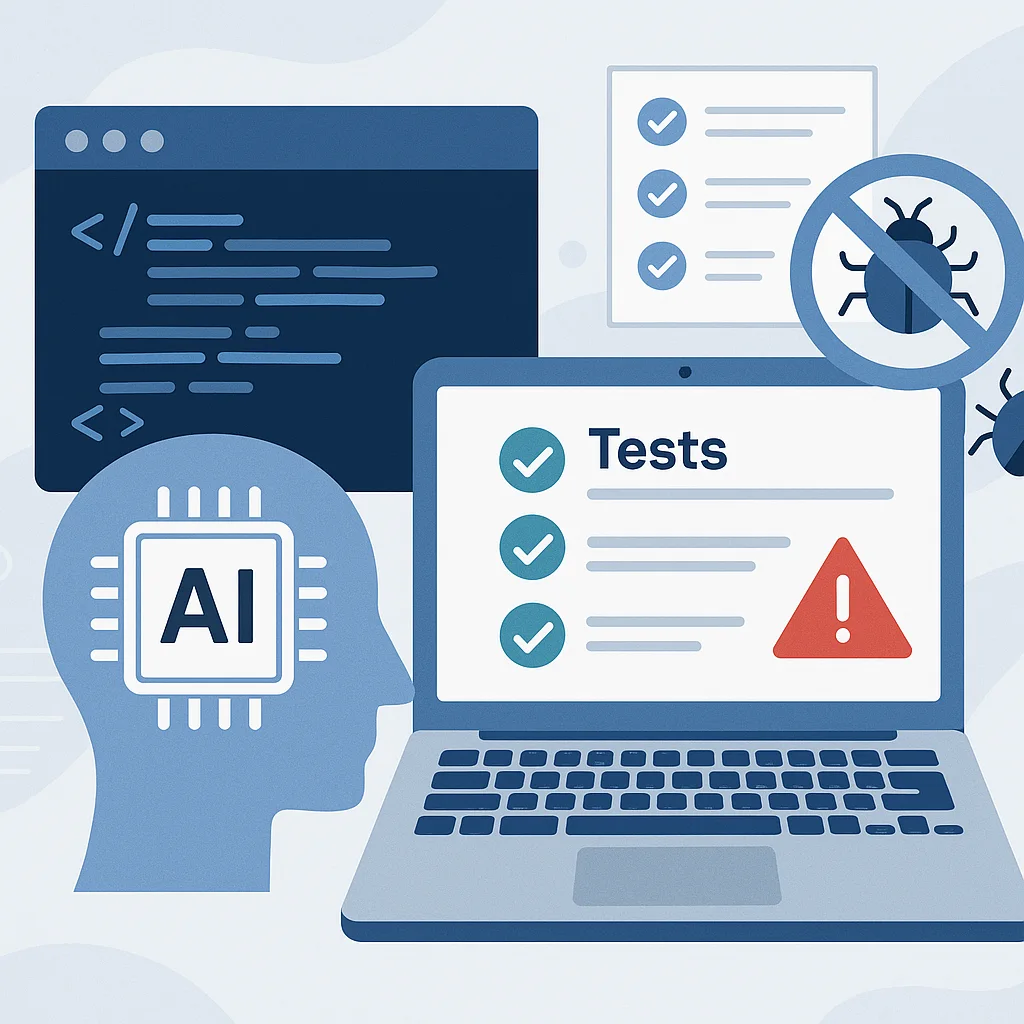

AI is no longer just an interesting add-on in software testing. In 2026, it has become a practical part of how QA engineers work, especially when teams need to move faster without losing depth, coverage, or quality.
Over the last few years, QA teams have increasingly used AI to support everyday work and keep up with deadlines. With the help of well-written prompts, engineers can speed up test design, automation planning, bug investigation, and reporting.
Many professionals already rely on AI for test generation and script improvement. Tools such as ChatGPT, Claude, and Perplexity help reduce repetitive work that often consumes a large portion of QA effort, especially in regression cycles.
In this article, you will find 30 useful AI prompts for QA engineers, including both simple prompts for quick tasks and expert prompts designed to produce richer, more context-aware results.
Why AI Prompts Matter in Modern QA Workflows
AI prompts help turn broad ideas into practical outputs. That alone makes them valuable, but they also bring several other advantages:
-
They reduce maintenance effort that often takes a noticeable portion of QA time
-
They improve the consistency and reliability of outputs
-
They help accelerate release cycles in AI-supported CI/CD pipelines
-
They improve the usability and completeness of generated test cases
-
They help reduce flakiness and increase defect detection when prompts are specific and structured
Weak prompts often produce partial or generic answers. Well-structured prompts, especially longer ones with proper context, usually lead to more accurate and actionable outputs.
QA communities also regularly discuss how detailed prompting saves time on data generation, exploratory ideas, and edge cases, while still requiring human review for compliance and final quality decisions.
Categories of QA Prompts Every Team Should Use
The 30 prompts in this article include both short prompts for quick wins and more advanced prompts for production-level work. They are grouped by workflow:
-
Test Case Design
-
Automation Testing
-
Bug Investigation
-
Performance and Security
-
Documentation and Reporting
-
Defect Triage and Analysis
AI Prompts for Test Case Design in Software QA
Generative AI is especially useful here. It can help create broader, more complete test coverage and uncover scenarios that are often missed in manual planning.
Simple Prompts
-
Generate detailed functional test cases for user login.
-
Create boundary value test cases for a date input field.
-
Suggest edge cases for a shopping cart feature.
Expert Prompts
-
You are a senior QA engineer working on a microservices-based web application for B2B customers. Given this user story: [paste user story + acceptance criteria], generate a complete suite of functional test cases. Structure the output as a table with these columns: Test ID, Title, Preconditions, Detailed Steps, Test Data, Expected Result, Priority, and Traceability linked to the relevant acceptance criteria IDs. Focus on both happy paths and high-risk negative scenarios, including validation failures, session behavior, and data integrity across services.
-
Act as a specialist in boundary value analysis and equivalence partitioning for financial systems. For this requirement: The amount field accepts values from 1 to 10,000 with up to 2 decimal places and currency = USD only, create a full set of boundary and partition-based test cases. Include valid and invalid ranges, data type violations, localization concerns, and formatting variations. Present the cases in a structured table with clear partition labels and assign each one a High, Medium, or Low risk level.
-
You are performing exploratory testing for a consumer mobile banking application. Based on this feature description: [paste description of funds transfer feature], generate session-based exploratory test charters. For each charter, include Charter ID, Mission, Areas of Focus such as security, usability, performance, and data consistency, Data or Tools Needed, and Timebox. Highlight at least 5 charters that specifically target edge cases, concurrency issues, and possible race conditions.
-
As a senior QA lead, design end-to-end test scenarios for an e-commerce checkout flow that integrates a payment gateway, inventory service, and order management system. Assume these constraints: [list constraints such as multiple currencies, guest vs registered user, discount codes]. Produce 10 to 15 high-level scenarios, each with a short narrative, key actors, involved systems, and the main risks addressed, such as data consistency, idempotency, and rollback behavior. Tag each scenario with its regression priority.
-
You specialize in accessibility testing for web applications. For a multi-step registration flow described here: [paste short description or URL], generate detailed accessibility test cases aligned with WCAG 2.1 AA. Include tests for keyboard-only navigation, screen reader behavior, focus management, color contrast, and error messaging. Structure the output with Test ID, Assistive Tech or Condition, Steps, Expected Accessible Behavior, and WCAG reference.
AI Prompts for Automation Testing in Software QA
Automation work can also be improved with strong prompts, especially when designing frameworks, building scaffolding, and reducing script maintenance.
Simple Prompts
-
Write a Selenium script for login.
-
Provide a Cypress API test template.
-
Outline a data-driven automation framework.
Expert Prompts
-
You are an automation architect designing a scalable UI automation framework using Selenium WebDriver, Java, TestNG, and the Page Object Model. Given this feature description: [paste login or key feature spec], generate: 1) a proposed project structure including packages, base classes, and utilities, 2) an example Page Object class with locators and reusable methods, and 3) a sample TestNG test class using data providers and validating both UI and backend conditions. Include comments showing where reporting and logging should be integrated.
-
As an expert in Cypress and modern frontend testing, design a Cypress testing strategy for a React SPA that depends heavily on APIs. Generate: 1) a set of high-value end-to-end tests, 2) a set of component and integration tests, and 3) example Cypress snippets for stubbing API responses with cy.intercept, handling authentication, and working with flaky elements. Explain how to tag tests for smoke versus regression and how to plug them into a CI pipeline.
-
You are a senior SDET responsible for API automation in a microservices architecture. Using REST Assured in Java, propose a design for an API automation framework that: 1) handles authentication such as OAuth2 or JWT, 2) supports data-driven tests from JSON or CSV, 3) uses reusable request and response builders, and 4) validates both functional behavior and contract compliance with JSON schema checks. Provide sample code for a critical API, including positive, negative, and contract validation tests.
-
Act as an automation strategist in a CI/CD environment using GitHub Actions and Docker. Given this tech stack: [stack details] and the goal of running regression tests on every pull request, propose: 1) a strategy for test suite segmentation such as smoke, sanity, and full regression, 2) a sample GitHub Actions workflow YAML that runs UI and API tests in parallel containers, and 3) criteria for failing builds based on test results and flaky test detection. Include notes on caching, parallel execution, and artifact collection.
-
You are designing a keyword-driven or low-code automation approach so that manual testers can also contribute scripts. Create a set of 20 to 30 high-level keywords such as CLICK, INPUT, VERIFY_TEXT, and WAIT_FOR_ELEMENT, and show how they map to underlying implementations in Selenium or Cypress. Provide an example test case written in a spreadsheet-style keyword format and the corresponding code that reads and executes it.
AI Prompts for Bug Investigation in Software QA
Flaky tests and hard-to-reproduce issues remain a major challenge. Good prompts can help QA engineers move faster toward a root cause.
Simple Prompts
-
Analyze possible causes of file upload timeout.
-
Give steps to reproduce UI flicker.
-
List common causes of flaky tests.
Expert Prompts
-
You are a senior QA engineer and performance specialist investigating intermittent 500 errors in a payment API. The stack is Node.js, Express, PostgreSQL, and Nginx, deployed on Kubernetes. Generate a structured investigation playbook that includes likely root causes, logs and metrics to collect, specific queries or log patterns to look for, recommended tracing such as OpenTelemetry spans, and a prioritized list of experiments to isolate the problem. Present it as actionable steps that a QA and developer pair can follow together.
-
Act as a debugging expert for flaky UI tests using Selenium in a cloud grid environment such as Selenium Grid or a cloud provider. Provide a detailed diagnostic checklist to identify the source of flakiness, covering timing issues, unstable locators, environment instability, test data dependencies, and conflicts in parallel execution. For each area, suggest concrete checks, useful tools such as video recordings and HAR files, and mitigation strategies like explicit waits or isolated test data.
-
You are a senior engineer helping QA analyze a defect where uploaded files sometimes appear corrupted in the system. The application uses a React frontend, Node.js backend, and object storage. Generate a root cause analysis template that guides QA in collecting reproduction steps, environment details, logs, network traces, and sample corrupted files. Suggest realistic causes such as encoding problems, chunked upload issues, proxy interference, and content-type mismatches, along with verification experiments for each one.
-
Act as a triage lead in a team that receives many similar bug reports about slow page loads in a dashboard. Create a process and template that QA can use to classify, deduplicate, and prioritize performance-related defects. Include fields for affected views, data volume, filters, browser, time zone, and related backend metrics. Propose tags and categories that can be used in a general test management workflow for clearer reporting.
-
You are mentoring a QA team on writing strong bug reports. Given this vague bug description: [paste example of a poor bug report], rewrite it into three high-quality versions: one for a functional defect, one for performance, and one for UX or UI. Each version should include a clear title, environment, preconditions, exact steps, expected versus actual behavior, attachments, and a hypothesis section to help developers narrow the investigation.
AI Prompts for Performance and Security Testing in Software QA
AI can also support non-functional testing by helping teams generate realistic performance scenarios and focused security checklists.
Simple Prompts
-
Create load test scenarios for an API.
-
Suggest SQL injection tests for login.
-
Generate a security checklist for user inputs.
Expert Prompts
-
You are a performance engineer designing a load testing strategy for a SaaS multi-tenant application. Tenant sizes range from 10 to 10,000 users. Using a tool like JMeter or k6, propose: 1) realistic user behavior models and scenarios, 2) ramp-up and steady-state configurations, 3) key metrics and SLAs such as P90 or P95 latency, error rate, and resource utilization, and 4) scaling experiments including stress, spike, and soak tests. Provide sample configuration snippets and a recommended reporting format.
-
Act as an expert in API performance testing for a high-traffic public API. For this endpoint description: [paste OpenAPI spec or short description], generate a detailed performance test plan that includes single-user baseline, concurrent load tests, rate-limiting behavior, and failure mode testing such as downstream dependency slowness. Specify test data strategies, environment prerequisites, and how to interpret common outcomes.
-
You are a security-focused QA specialist performing testing on an authentication and authorization module. Based on this description: [feature or flow description], generate a prioritized checklist of security tests covering the OWASP Top 10 areas most relevant to authentication, such as broken authentication, broken access control, injection, and session management. For each item, include example test ideas, tools such as Burp Suite or OWASP ZAP, and what evidence QA should capture.
-
Act as a penetration tester helping a QA team strengthen input validation. Given sample endpoints and fields: [list endpoints or fields], design a suite of malicious payloads and test ideas for SQL injection, XSS, command injection, and deserialization risks. Organize them in a format that can later be converted into automated security regression checks, and clearly mark which tests are safe only in lower environments.
-
You are responsible for validating non-functional requirements for an analytics dashboard that must render large datasets efficiently. Create a test plan that covers browser-side performance such as render time, memory usage, and CPU spikes, API performance such as aggregation queries, and frontend optimization checks such as lazy loading, pagination, and virtualization. Include tools like Lighthouse, browser dev tools, and profiling utilities, along with simulated data volumes and pass or fail thresholds.
AI Prompts for Test Documentation and Reporting in Software QA
AI can help QA teams create more consistent documentation and clearer reporting, especially when traceability matters.
Simple Prompts
-
Create a bug report template.
-
Write a weekly QA summary.
-
Generate test notes for a registration feature.
Expert Prompts
-
You are a QA lead setting up documentation standards for a distributed team. Design a test documentation structure that includes test strategy, test plan, test design specifications, execution reports, and retrospectives. For each artifact, describe its purpose, minimum required sections, recommended templates, and how it should link to requirements, defects, and test runs within the team’s workflow.
-
Act as a QA manager preparing an executive-level release quality report for a major release. Given these high-level metrics: [insert sample metrics], generate a narrative report that explains test coverage, defect trends, key risk areas, and release recommendations in language suitable for non-technical stakeholders. Structure it with sections for Overview, Highlights, Risks, Mitigations, and Next Steps. Also indicate where visuals or charts should be inserted.
-
You are documenting a complex integration testing effort involving multiple third-party APIs. Create a documentation template that QA can use to capture integration points, mock versus live environments, known limitations, external SLAs, and rollback strategies. Provide an example of a completed version for a payment gateway integration.
-
Act as a senior QA responsible for UAT coordination. Generate a UAT test plan outline that includes participant roles, entry and exit criteria, environment setup, business-friendly test scenarios, defect triage process, and sign-off steps. Show how this plan should connect back to system tests, regression coverage, and requirements.
-
You are responsible for creating a reusable test data documentation standard. Define how QA should document test data sets, including anonymization rules, synthetic data generation approaches, refresh cycles, and links between data sets and specific test cases. Provide an example of well-documented test data for a login and profile management feature.
AI Prompts for Defect Triage and Analysis in Software QA
Defect triage is another area where AI can save time, especially when teams need to organize, group, and prioritize defects quickly.
Simple Prompts
-
Look at this bug report and help me improve it by making the title clearer, rewriting the reproduction steps, and separating expected versus actual result: [paste bug report].
-
Here are several related bug reports from different testers. Help me identify duplicates and suggest one merged defect description: [paste bug reports].
-
These are the open defects for the current sprint with severities and modules. Help me group them by module, highlight the riskiest areas, and suggest which defects must be fixed before release: [paste defect list].
Expert Prompts
-
You are a senior QA lead triaging defects from a sprint regression cycle. Given this set of 15 defects with descriptions, screenshots, and logs: [paste defect list], perform initial triage and produce a prioritized table with columns: Defect ID, Summary, Severity, Priority, Category, Root Cause Hypothesis, Assignee Recommendation, and Duplicate or Invalid flags. Highlight any cross-cutting patterns or release blockers.
-
Act as a defect analysis specialist for a microservices application. For this high-priority defect report: [paste detailed defect], generate a structured root cause analysis template including Reproduction Checklist, Environment Matrix, Log Analysis Questions, Related Test Failures, Impact Assessment covering users affected and business risk, and Next Actions such as developer investigation, workaround, and needed regression tests.
-
You are triaging intermittent failures from automated UI tests in CI/CD. Analyze this test failure log excerpt: [paste log], and produce a diagnostic report covering failure pattern, likely causes such as flaky elements, environment issues, or race conditions, verification steps, mitigation recommendations, and retest priority.
-
As a QA triage manager, you are consolidating duplicate defects from multiple sources such as issue trackers and manual reports. Given these similar reports: [list 5 to 7 defects], create a master defect record with a consolidated title and steps, linked defect IDs, severity consensus, trend analysis across frequency and environments, and a communication plan for stakeholders.
-
You specialize in post-mortem defect trend analysis for release quality gates. Using these sprint metrics: [paste defects by type, escape rate, severity distribution], generate an executive summary with Key Trends, Root Cause Categories such as code changes, test gaps, or environment issues, Action Items for the Next Sprint, and a Risk Heatmap for critical paths.
Best Practices for Writing Effective QA Prompts
If the prompts above are not enough, you can always create your own. But the real value comes from writing prompts that are clear, structured, and grounded in actual QA work.
1. Focus on role, context, and goal
Tell the AI who it should act as, what system it is working on, and what kind of output you want.
For example, say: You are a senior QA engineer testing a B2B web application. Include the domain, stack, and whether you need test cases, bug analysis, or risk assessment.
2. Provide concrete inputs, not vague ideas
Use real artifacts such as user stories, acceptance criteria, API specifications, logs, or bug reports instead of abstract descriptions.
Paste the smallest self-contained piece of information that still includes enough detail. Label sections clearly, such as User Story, Acceptance Criteria, or Logs.
3. Specify the structure and format of the output
Tell the AI exactly how to return the answer, whether as a table, checklist, or structured sections.
Define the columns or fields you need, such as Test ID, Steps, Test Data, Expected Result, Priority, and Traceability, so the result can be reused with minimal cleanup.
4. Emphasize risk, coverage, and traceability
Explicitly ask for high-risk flows, negative scenarios, and references back to requirements or defect IDs.
For example, request both happy path and negative coverage, and ask to map test cases to acceptance criteria.
5. Limit scope and depth
Keep each prompt focused on one specific task, such as test design or bug report improvement, rather than trying to cover an entire QA process in one request.
Also define quantity and depth, such as 10 to 15 high-priority scenarios or top 5 risks.
6. Make review and iteration part of the process
Treat AI output as a draft that still needs review.
Follow up with prompts such as improve edge case coverage, remove duplication, or rewrite this in a concise format suitable for test management.
7. Align prompts with real workflow
Design prompts around the places where they actually fit in your process, such as test design, automation backlog preparation, triage, reporting, or UAT support.
Add instructions like output must be ready to paste into our test case template or optimize for quick reading in standup.
How QA Teams Can Integrate AI Prompts into Daily Workflow
Integrating AI prompts into daily QA work turns large language models into practical assistants rather than novelty tools.
A useful approach is to define where AI fits in a normal sprint, such as test design, bug investigation, regression planning, or release reporting. It should also be clear that AI produces drafts, while QA engineers remain responsible for review and final decisions.
Teams often start by pasting expert prompts into AI tools during test design or bug analysis, then cleaning up the structured outputs before placing them into their existing QA workflow.
It also helps to run short internal workshops where testers practice refining prompts with real user stories, logs, and defects. Teams usually see better results when prompts include context, constraints, and expected structure.
Strong prompts can also be shared during standups or QA syncs so the team builds a reusable library of what works well for new features, tricky edge cases, and recurring defect patterns.
Finally, AI-generated content should go through the same review process as any other QA artifact. Human oversight is what catches weak assumptions, gaps in coverage, and misleading conclusions.
Closing Thoughts
AI prompts are no longer just a nice extra for QA engineers. In 2026, they are a practical way to speed up testing, reduce repetitive effort, and improve coverage.
When prompts are written with clear goals and enough context, AI becomes a reliable support layer in day-to-day QA work.
The future of software quality is not AI alone. It is thoughtful collaboration between human expertise and AI assistance. And strong prompts are what make that collaboration useful.