
Some engineering tasks are easy to specify with precision: write a PDF parser, implement IMAP correctly, or build a compiler against a defined language specification. The work may still be difficult, but the goal is clear enough that a machine can keep iterating—trying, checking, and refining.
Testing includes many tasks of the same kind: test a parser with malformed inputs, verify that an API truly meets its contract, or confirm that a refactor did not change outputs for the same data. When the expected behavior is unambiguous and the team can clearly distinguish right from wrong, AI agents are already strong at this kind of repetitive iteration. They generate and run cases, analyze failures, adjust their approach, and continue.
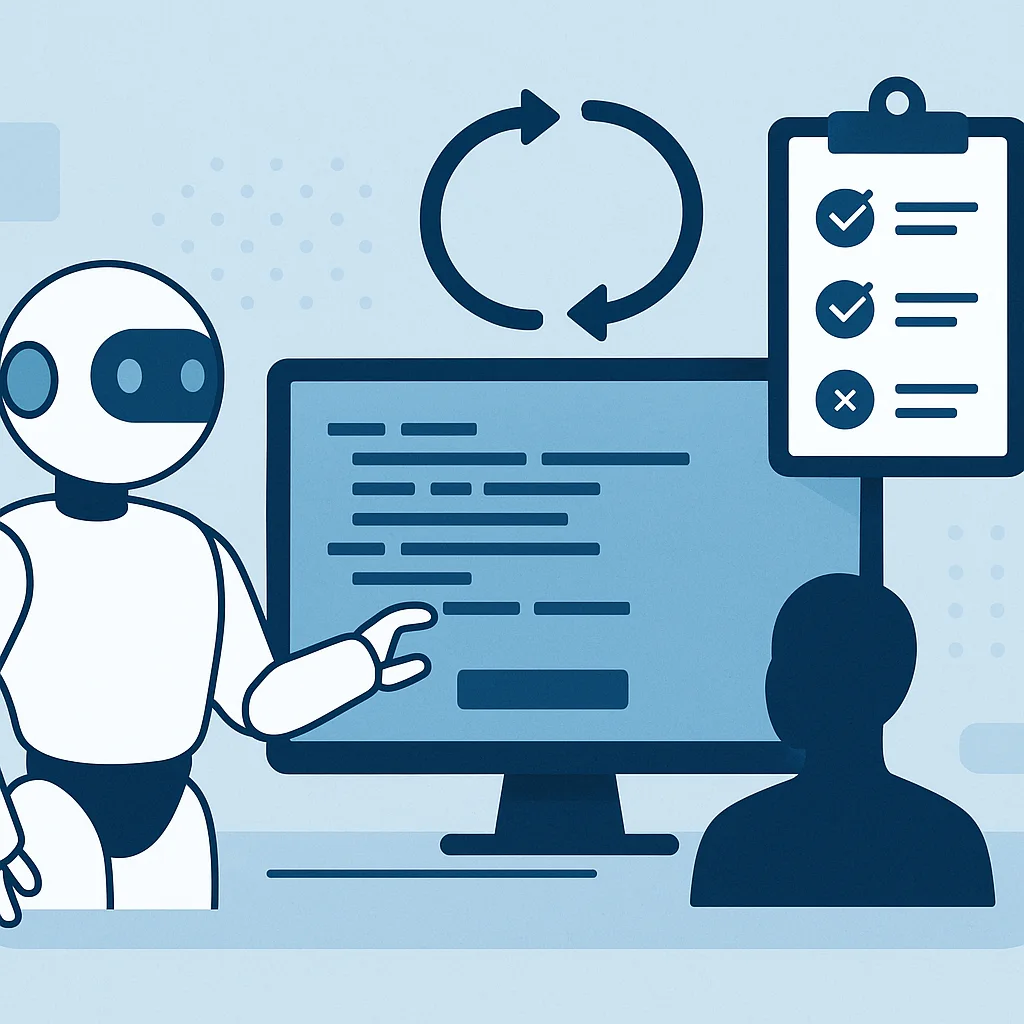
Developers often describe this pattern as a Ralph loop, named after Ralph Wiggum in The Simpsons. You run the agent and let it modify the code or the test suite, review the result, and then start again in a new session until the task is complete. For work with a clear target and fast feedback, this loop can be highly productive.
Manual testing remains important because much of software quality does not resemble parser work.
Where agent loops already work well
Agent-driven testing performs best when the team can clearly define what they are trying to prove and how they will know whether it works. If the behavior is well-specified, the system is stable enough to learn from each attempt, and feedback arrives quickly, agents can deliver substantial value.
This includes more testing work than many teams expect. Parser and protocol testing are obvious examples. The same is true for API contract tests, import/export validation, migration verification, and data checks where the primary question is whether the software continues to behave as intended across many use cases.
That is why AI-assisted testing feels especially compelling in lower-level systems and at system boundaries. Each iteration has a clear foundation. Failures are easier to interpret, progress is easier to measure, and coverage can be tightened with each cycle.
Where the loop starts to drift
Problems emerge when the key question is no longer only correctness.
A product flow can meet its written requirements and still be confusing. A payment failure screen may function correctly yet leave the user unsure what to do next. A support assistant can comply with policy while still making the user feel stuck. These issues are harder to fit into a tight automated loop because the standard is less formal.
In principle, agents can improve here. There is nothing inherently magical about a human tester opening a product, reading a specification, reviewing screenshots or session recordings, and deciding whether common scenarios are covered. A sufficiently capable system could ingest the same inputs and approximate that judgment, and some teams are already experimenting with elements of this approach.
But the workflow is still brittle. It is easy to choose the wrong scenarios or to mistake variety for relevance. As a result, the loop can keep running while gradually drifting away from what the team actually cares about.
At that point, a human is no longer just a fallback. The human becomes the control layer.
What the human control layer actually does
Describing manual testing as a control layer is more precise than simply saying humans still matter. The role is to determine whether the loop is moving in the right direction, not to click around aimlessly after automation finishes.
In practice, this means selecting which user journeys and risks deserve attention, and validating that generated scenarios resemble real usage rather than arbitrary variation. It includes evaluating outcomes that require judgment rather than a simple pass/fail, and redirecting the loop when the agent is optimizing for the wrong objective.
The difference becomes clearer when comparing two very different assignments. “Build automated checks for this IMAP implementation and iterate until the protocol tests pass” is excellent work for an agent. The problem is structured, and the team can easily tell whether progress is genuine.
“Check whether first-time users can recover from a failed identity verification flow on mobile without losing trust in the product” is different. Parts of it can be automated. An agent can try different device states, generate test ideas, review screenshots, exercise retries, and flag inconsistencies. But a person still needs to assess the interaction and decide whether it makes sense. The real question is not only whether the code did what it was instructed to do, but whether the product handled a human situation well.
Sometimes the gap is technical: current agents are not yet dependable enough to absorb all relevant signals and make a consistent judgment. Sometimes the gap is deliberate: an organization may want a person—not a model—to make the final call on issues such as clarity, trust, fairness, safety, or brand risk.
Manual testing changes shape, not value
The traditional manual-versus-automation framing is becoming less useful.
The repetitive portion of manual testing will continue to shrink wherever the work can be formalized, and teams should welcome that. If an agent can spend the night generating parser edge cases or expanding regression coverage around a data import flow, assigning the same work to a person adds little value.
What remains for humans is more consequential. Direction, relevance of coverage, and interpretation matter more than sheer execution volume. Manual testing becomes the practice of judging whether the system is learning the right lessons.
Strong manual testers are likely to become more valuable over time. A fast loop pursuing the wrong objective produces false confidence faster, and someone needs to detect that early.
A workable operating model
For the next few years, the most practical approach is a supervised loop.
Teams can formalize what truly can be formalized and let agents iterate aggressively on bounded tasks with clear exit conditions. They can add human review where scenario selection or outcome meaning becomes ambiguous, then feed those findings back into the next cycle as improved prompts and tighter constraints.
Over time, some work will shift from the human side to the autonomous side. Agents will get better at reading product specifications and session recordings. They will also improve at interpreting accessibility signals and visual flows. As a result, the range of testing tasks that can run in a loop with minimal supervision will expand.
Even then, there will still be areas where teams want human judgment because the question goes beyond whether the system behaved consistently—it is about whether the behavior makes sense. That is how much testing is likely to operate in the coming years: agents handling more systematic work that can be formally described and repeatedly verified, with humans staying involved where the work is complex or where the organization requires explicit human judgment before trusting the outcome.
Seen this way, manual testing is more than the leftover work automation cannot cover. It is the control layer that keeps AI-assisted testing anchored to product reality. It decides whether the loop should continue or change direction. Teams that do this well will evaluate manual testing by whether those human checkpoints improve the quality of the loop.