
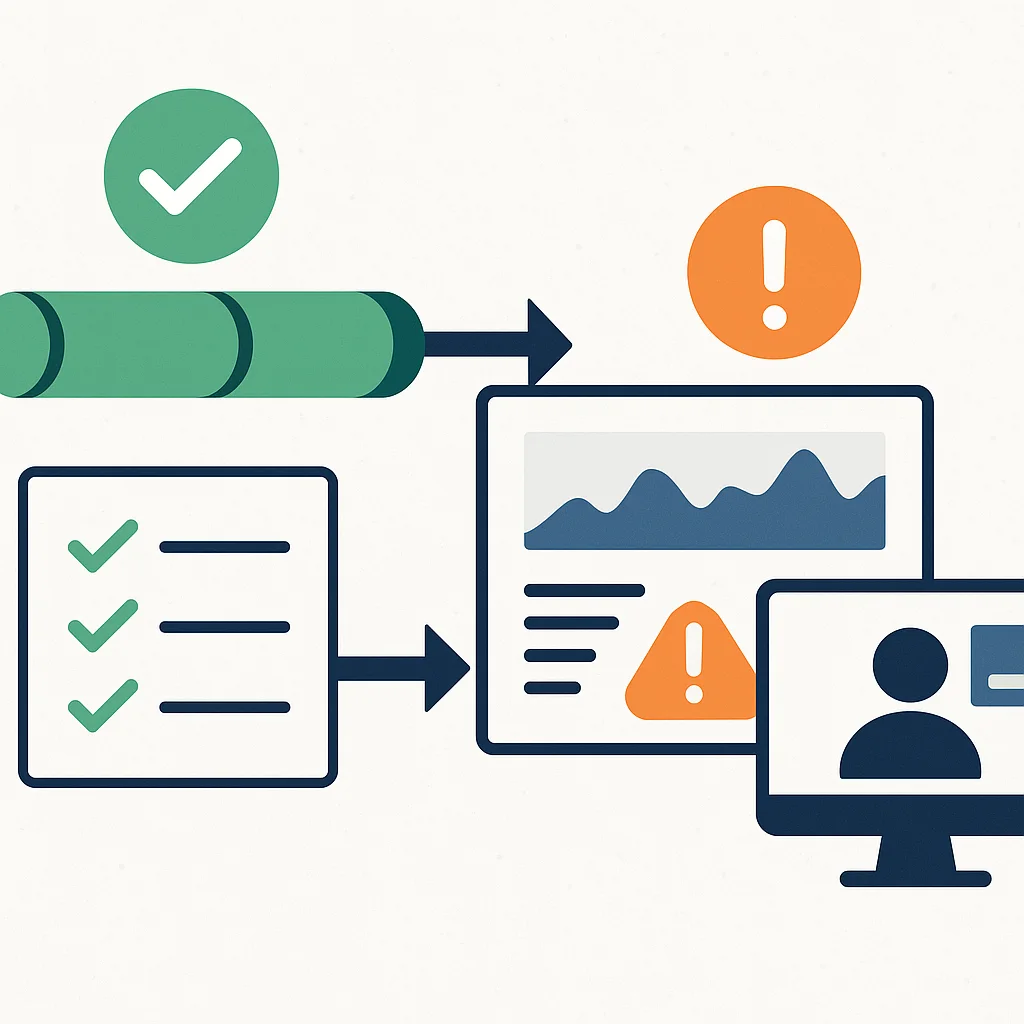
A green CI pipeline does not automatically mean it is safe to release, and most teams already understand that.
Why? Because software can pass every test with ease and still offer no guarantee that it will not fail in production.
The core issue is the large gap between controlled testing and what happens with real users (e.g., unpredictable behavior, unstable infrastructure, and so on).
Naturally, you want to narrow that gap, but how? You need to examine production telemetry—logs, request metrics, trace data, and real user interactions. This is how you learn how people actually use the software, and without that visibility, the work becomes much harder.
The argument is straightforward.
Production data is proof of what occurs under real-world (non-ideal) conditions. When QA teams can review this data, they can determine whether their tests reflect what truly happens in production.
Why Passing Tests Still Fail in Production
The frustrating reality is that tests can all pass while production is still on fire. How is that possible?
It starts with the environment. Test environments are clean and quiet—controlled setups where variables are limited, behavior is not representative of real usage, the data is synthetic, and the services are often mocked.
Production is the opposite. It is messy, and users interact with the software in ways no one fully anticipated.
Data is different, too. Tests typically use tidy datasets.
Real users, however, may enter nonsense input and click unpredictably, creating scenarios you did not plan for. Tests also tend to cover what you expect to happen, so that is what gets validated.
What is often not visible is what happens inside the system under real stress (e.g., memory pressure, cascading service failures like dominoes, and so on). Many issues remain hidden until the system experiences high traffic or long runtimes.
This means that non-stressful tests and/or quick tests will rarely uncover these kinds of problems.
The point is not to blame tests—they do exactly what you design them to do. The problem is that you cannot anticipate everything. Production telemetry, however, reveals what you missed, and once you can see it, you can address it.
Converting Production Telemetry into Actionable Test Improvements
To make validation meaningfully stronger, you need a mindset shift. Telemetry is not merely something that alerts you when things are breaking; it is structured evidence of how the system actually behaves. When you view logs, metrics, and traces this way, they become a roadmap for improving tests.
Take structured logs, for example.
By analyzing them, you can spot recurring exceptions or warning patterns that staging would never reveal. You can map those exceptions back to existing test cases and determine whether the failures were anticipated or entirely missed.
From there, QA teams can build new regression tests based on real error payloads seen in production (properly sanitized, of course).
Examples of new regression tests that we can make from production telemetry:
Metrics add another layer of insight.
Performance tests often rely on assumptions about how quickly a service should respond. Production metrics can either confirm those assumptions or challenge them. These assumptions are commonly captured as service level objectives (SLOs).
SLOs are clearly defined targets for latency, error rates, and availability.
And production metrics can validate those targets while also exposing gaps between what is expected and what actually happens in real-world conditions.
Examples of production telemetry signals that should indicate new test cases are required:
For example, when systems depend on time-sensitive external services—such as APIs with hourly and daily forecast endpoints—production data may reveal timeout spikes or response variability that mocked tests never simulated.
That evidence can guide the creation of resilience tests that more accurately reflect real dependency behavior.
Distributed tracing is also crucial because it helps show what went wrong by revealing flow and timing. It will not always provide the root cause, but it can indicate where the problem likely is.
It is essentially system-wide, observational “debugging,” except it is not interactive.
Beyond the technical signals, it is also essential to pay attention to what users actually interact with and how they do it. For instance, if one page receives heavy traffic every day, it makes sense to prioritize resources there rather than on pages that see minimal usage.
This creates a feedback loop between operations and QA.
Operations detect an anomaly and analyze it. If gaps in test coverage are suspected, QA may join during the analysis stage. This is where QA typically comes in—evaluating what the results imply. After that evaluation, QA improves the tests (with operations sometimes assisting through tooling and instrumentation), and the cycle repeats.
This loop helps reduce repeated occurrences of the same anomaly.
Conclusion
Tests are unbiased and polite. They do what you ask—nothing more, nothing less. They are simple, orderly, and organized.
Production, by contrast, is chaos.
Users click in unexpected ways, the internet slows down or fails for no clear reason, people abandon flows partway through without explanation, and users do things no one considered—leading to crashes and exploits. Then a third-party service the system depends on goes down, and servers become overloaded.
Automated tests need to work alongside production telemetry, because it is the only reliable way to understand what happens when conditions get messy.
The real value is that QA teams can use this data to build something stronger and more resilient.