
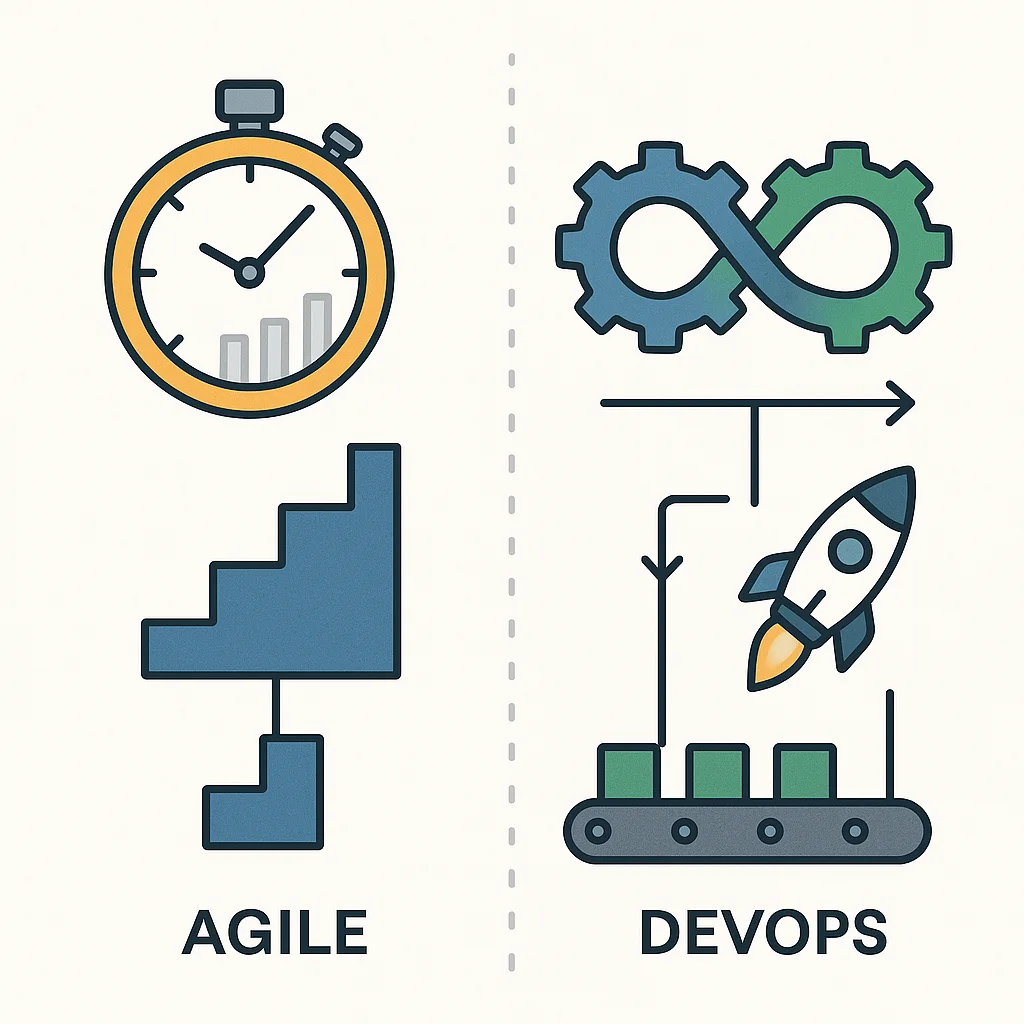
For the past two decades, Agile has been the gold standard. By replacing Waterfall’s slow pace with the steady rhythm of sprints and stand-ups, it reshaped how software gets built.
But the industry has shifted again. The rise of DevOps and CI/CD has accelerated delivery, shrinking release cycles from weeks to minutes.
In this high-velocity environment, a rigid, “textbook” approach to Agile is falling short. In particular, Scrum is starting to look less like an accelerator and more like a bottleneck.
The root tension is cadence. Textbook Agile typically runs on two-week sprints. DevOps aims for continuous flow. You cannot force a continuous release cycle into a fixed two-week container without friction. It is a clash of philosophies. Developers grow frustrated, and QA teams end up scrambling.
The Speed Mismatch
The central problem is straightforward. Strict Agile ceremonies were built for a time when releasing software was a major event. In a true DevOps environment, releases should be routine. They should happen multiple times per day.
When a team insists that nothing goes live until the end of the sprint, it artificially delays value. The mismatch between tools and expectations becomes obvious. It is like a student choosing to write an essay using EssayService.com to save time, only to discover the assignment requires a live oral presentation.
The approach does not fit the requirement. A two-week feedback loop is far too slow for a pipeline that can deploy in ten minutes. At that point, the process becomes an anchor instead of a sail.
Here are the specific areas where speed mismatches occur:
The Ceremony Overload
Textbook Scrum depends on a heavy schedule of synchronous meetings. Teams attend daily stand-ups and sprint planning, along with backlog grooming and retrospectives.
High-speed DevOps cultures lean toward asynchronous communication. ChatOps is the norm. In that setting, traditional meetings can feel dated.
Imagine a developer fixes a bug at 10:00 AM. Automated tests pass fifteen minutes later. The change is in production by 10:30 AM. There is no need to wait until the next morning to report it, and no reason to wait two weeks to demo it.
Strict adherence to these ceremonies often erodes productivity. Many high-performing teams are adopting faster habits to keep up:
The “Water-Scrum-Fall” Trap
One of the most common failure modes is “Water-Scrum-Fall.” Development runs in Agile sprints, but the surrounding processes stay rooted in Waterfall. This often affects budgeting, requirements gathering, and operations.
In this setup, developers race to finish code within the sprint, but the work accumulates in staging because Operations is not ready to deploy. Sometimes QA requires a manual “stabilization phase.” The outcome is a backlog of undeployed work that deteriorates over time.
Phil Collins, an expert contributor to EssayService, a professional essay writing service, observes that this fragmentation is risky. He compares it to using AI to generate a draft without proofreading. Even if each part is produced quickly, the lack of integration creates a disjointed failure.
To address this, the barriers between “Dev” and “Ops” must fully disappear. That change needs to be real in process, not just in name.
Moving From Sprints to Flow
For many teams, the answer is to move away from Scrum’s rigid time boxes. Instead, they choose Kanban or Lean methodologies. These approaches emphasize flow rather than fixed intervals.
In a flow-based system, there are no sprints. Work is pulled from the backlog and deployed as soon as it is ready. This shift demands a high level of maturity and depends on the following technical foundations:
This can feel intimidating for traditional managers. However, it is the only way to unlock the full promise of DevOps.
Conclusion
Agile is not dead. But the “textbook” version of it is fading. Rigid Scrum ceremonies conflict with the speed of modern CI/CD pipelines.
To succeed in a modern DevOps culture, teams must let go of tradition. Success depends on mastering these three priorities: